How the skills work
The skills are the platform's front door. You talk about your day - a 1:1, a worry, a fuzzy goal - and a skill turns the conversation into structured platform rows. This page is the contract: the trust guarantees every skill honors, the frameworks they enforce as hard gates before anything is written, and how the write funnel makes it impossible for the automation to corrupt your data.
1The front door
You rarely fill a form. You say "log my 1:1 with Lena", "any risks in this transcript?", "build the board report" - the matching skill reads the source (usually a Fireflies transcript), extracts a structured draft, shows it to you, and writes it to the platform on your yes. The screens in the User guide are what those writes look like the next morning.
Two things make the front door coherent:
- One skill per job. Each moment of your week has exactly one owner: the 1:1 logger logs 1:1s, the risk detector logs risks, the task manager writes tasks. Skills that need each other delegate - they never duplicate.
- Qira routes the composite work. When a request spans more than one skill - "close the quarter for Acme", "run my weekly sweep", "review risks and check in OKRs" - qira is the orchestrator: she plans the chain, confirms the whole plan once, dispatches the specialist skills in order, and reports back with links. Single-skill requests go straight to the skill.
A few surfaces stay external by design. The BigMac capability grid lives in Airtable and the EM Library in Notion. OKRs are dual-homed: Tability stays the system of record - the OKR skills write there first, then mirror the same objectives into the platform so /okrs shows the quarter in-product. The mirror is idempotent and never blocks the Tability write.
2The guarantees
Six behaviors hold across every skill. They're the reason you can let a routine run on your data unattended and trust what comes back.
Identity is never guessed
Before any write, a skill resolves a name to a specific person in your account, through one shared resolver. One confident match, or it stops and asks. It will not invent a teammate or attach a note to the wrong person.
Every write is idempotent
Each record carries a stable source_key. Run the same skill on the same call twice and you get the same row updated in place - never a duplicate. Routines can safely re-run; the backfill can replay months of history.
The database computes the numbers
Satisfaction scores, risk bands, delivery pace, staleness - all computed by fixed rules in the database from the underlying facts. The skill supplies evidence and flags, never a score. Same inputs, same number, every time.
Extraction is conservative
A signal fires only when a verbatim quote backs it. On a hedged or noisy call the skill under-claims rather than over-reads - except for exit-risk, which is deliberately high-recall.
Nothing lands behind your back
Interactive skills show you the draft and wait for your yes. The routines stage judgment calls - risks, feedback, conversation logs, carry-forwards - as tick-to-approve proposals. Read-only skills are locked read-only.
One writer per record
Each kind of record has exactly one skill that owns writing it; everything else delegates. No two skills race to own your tasks, your risks, or your 1:1s.
3Frameworks as hard gates
The skills don't just format your input with a management framework - they enforce it. Each writing skill encodes its framework as pre-write gates, and vague input fails the gate. The skill pushes back with what's missing instead of writing a mushy record.
| Skill | Framework it enforces | What the gate refuses |
|---|---|---|
em-risk-detector | PRINCE2 cause → event → impact | "I'm worried about the client" - no risk lands without a concrete cause, the event it could trigger, and the impact if it does. |
em-feedback-builder | SBI (situation - behavior - impact) | Trait talk ("be more proactive") - feedback needs the specific situation, the observed behavior, and its impact. |
em-conflict-logger | NVC (observation / story / need / request) | Judgment dressed as fact - the gate separates what was observed from the story being told about it before a conflict is logged. |
em-goal-setter | SMART, five gates (S/M/A/R/T) | "Get better at Kubernetes" - a goal must be measurable and dated or it doesn't become a growth path. |
em-stakeholder-mapper | MEDDICC + Mendelow power/interest | A name and a title - a stakeholder is recorded only once qualified against both models. |
em-okr-builder / -reviewer / -scorer / -auditor | The OKR quality rubric | Activity-shaped or unmeasurable key results - the rubric gates the write, and the platform mirror re-enforces the measurable-target rule in the database. |
The same pattern runs deeper in the fleet: em-career-1on1 runs a career conversation as four gates (aspiration → next-role gap → dated actions → your commitment), em-postmortem-logger has a blameless gate, and em-onboarding-plan-builder rejects vague or activity-shaped milestones - every milestone needs an outcome, a criterion, evidence and a target date. The payoff: everything in the platform is comparable, because nothing got in below the bar.
4The write funnel
Every durable write - from a skill, a routine, or the web app itself - goes through the same funnel, and it's why a skill cannot corrupt the platform:
- The skill validates - identity resolved, framework gate passed, your confirmation given.
- Then it writes through a single guarded database function for that record type. The function re-checks that the caller can access that account and engagement, enforces the record's shape, and applies the idempotency key. Skills have no raw table access - the guarded functions are the only door, so a confused or buggy caller can be refused but can't scribble.
- Reads are always live views. What a skill reads is exactly what you see in the app - no exports, no sync lag, no second copy to drift.
- Owner-only records stay private by row-level security. 1:1 well-being notes, conflicts, coaching scorecards, meeting load, carry-forwards - the database returns those rows only to their owner. Oversight roles get derived scores, never the narrative. A skill running as you sees what you see; nothing more.
5After a 1:1People
em-1on1-logger is the one you'll feel most. It reads the 1:1 transcript and writes the session: a summary, action items, blockers, your asks, wins, and up to nine satisfaction signals - each anchored to a quote from the call. It does not pick the score. It passes the signals to the database, which computes the 0-10 satisfaction score, the risk band, and the exit-risk cap by fixed arithmetic.
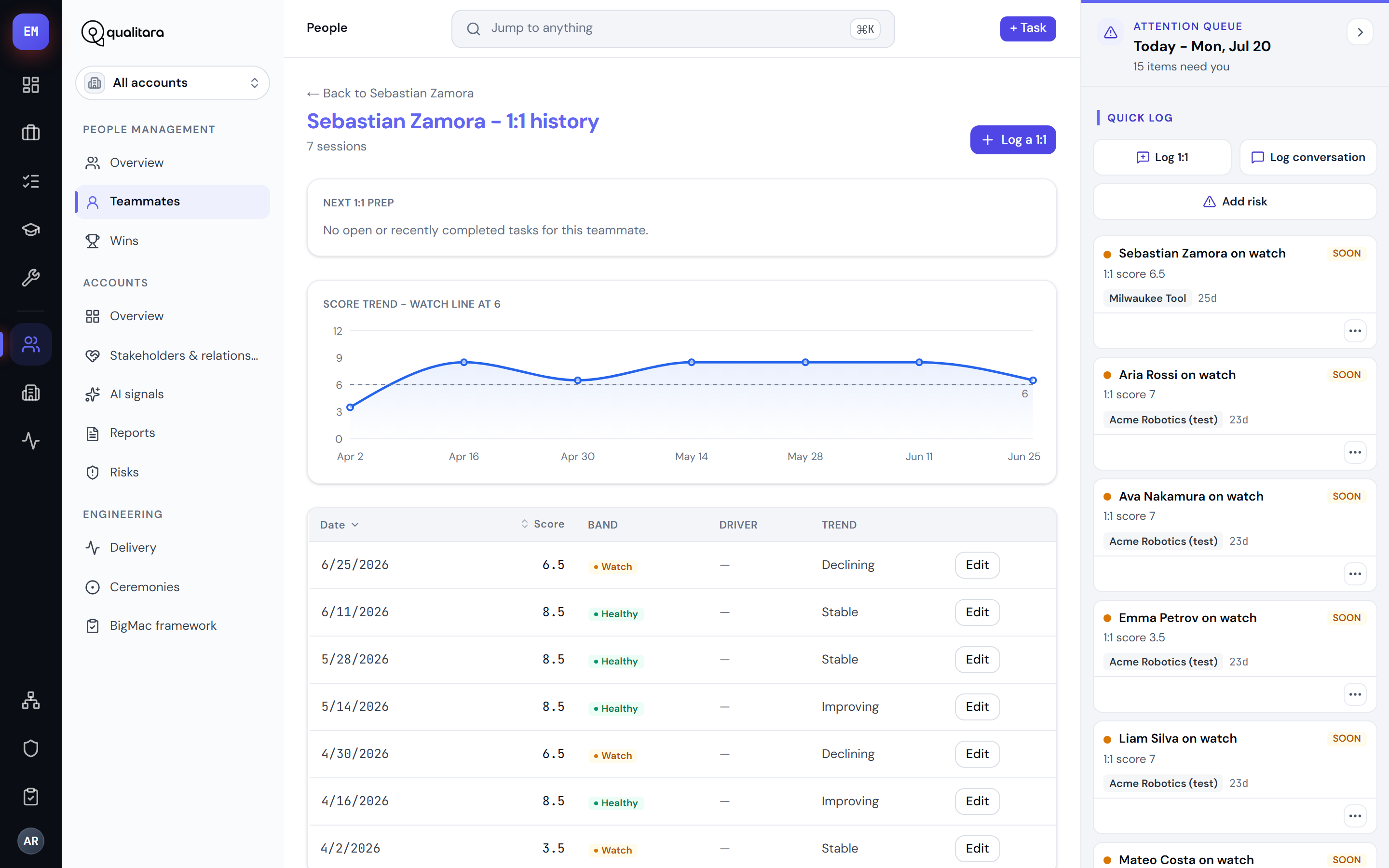
Behavior worth knowing:
- Personal context is siloed. Anything about someone's life outside work goes only into the owner-private well-being note - never into the summary, the signals, or the score.
- It aborts on the wrong person. If the teammate has offboarded, or the speaker isn't in the resolved account, it stops rather than write a bad record.
- It never creates tasks. It hands your action items to the task gate (see section 9), which decides what becomes a task.
A family of people skills rounds out the loop, all landing on the person's profile:
- em-feedback-builder turns a coaching moment into an SBI email draft - it drafts, never sends - and em-feedback-follow-up re-checks logged feedback when it's due, so you mark each item done, escalated or snoozed and nothing you raised quietly drops.
- em-career-1on1 runs a career conversation through its four gates and records a growth path; em-goal-setter does the same for a single fuzzy intention via the SMART gates.
- em-conflict-logger structures a conflict with NVC and logs it - conflicts are owner-only records.
- em-skip-level-logger captures a skip-level session and shows the rollup trend on the engagement.
- The onboarding trio: em-onboarding-plan-builder builds the 30-60-90 plan (and schedules the day-30/60/90 checkpoint tasks), em-onboarding-reviewer runs each checkpoint - it proposes did/didn't with evidence from 1:1s and transcripts, never ticks a milestone for you - and em-onboarding-closer closes the plan with the 90-day retro and the final stakeholder summary.
- em-performance-review-drafter gathers one person's evidence and drafts the review sections into the in-app review record - it never rates and never finalizes; those clicks are yours, on the review page.
- em-english-assessor is a proof-of-concept that estimates a teammate's spoken-English CEFR level from their meetings, as a local report.
6After a standup, retro or ceremonyEngineering
em-standup-logger writes one standup record plus a per-person line, from the transcript. It captures who actually attended (not who was invited, and it names absentees), the duration, each person's progress-or-blocker anchor (with big-blocker classification), and a set of deterministic red flags - over-timebox, a silent member, a dominated meeting, a persistent blocker - each backed by an observation. If a speaker doesn't match anyone in your team, their line is omitted rather than pinned to a guessed identity.
em-retro-logger writes the retro - what went well, what didn't, themes, decisions, and every owner's action items - and adds two backward looks by fixed rule: recurring issues (measured overlap against prior retros, not a vibe) and whether last retro's actions actually got done ("no confirmation means not done"). Its headline flag is a recurring theme whose prior action was left undone. "Change over catharsis."
em-ceremony-logger covers the rest of the cadence - sprint planning, sprint review, backlog refinement - each with per-kind structure and its own red-flag rules. em-kickoff-logger captures a project kickoff and offers to spawn its goals into tasks and risks; em-postmortem-logger logs an incident postmortem behind a blameless gate.
On Fridays, em-standup-weekly-report reads the week's standups and computes the cross-day patterns - repeated status with no progress, persistent blockers, who went quiet - into a team-health report for your 1:1 prep. It reads the records and writes none.
The BigMac skills audit the practice itself: soft-audit drives the quarterly hand-filled audit you see in-app on the engagement, bigmac-run runs the full framework audit and writes the snapshot into the in-app grid, capability-audit deep-dives one capability, and sprint-audit audits ceremonies against the framework and generates the client / internal / board reports you flip between in the report viewer.
7Risk handlingAccounts
Risk is a five-skill loop, and the golden rule is that nothing is written without your explicit yes.
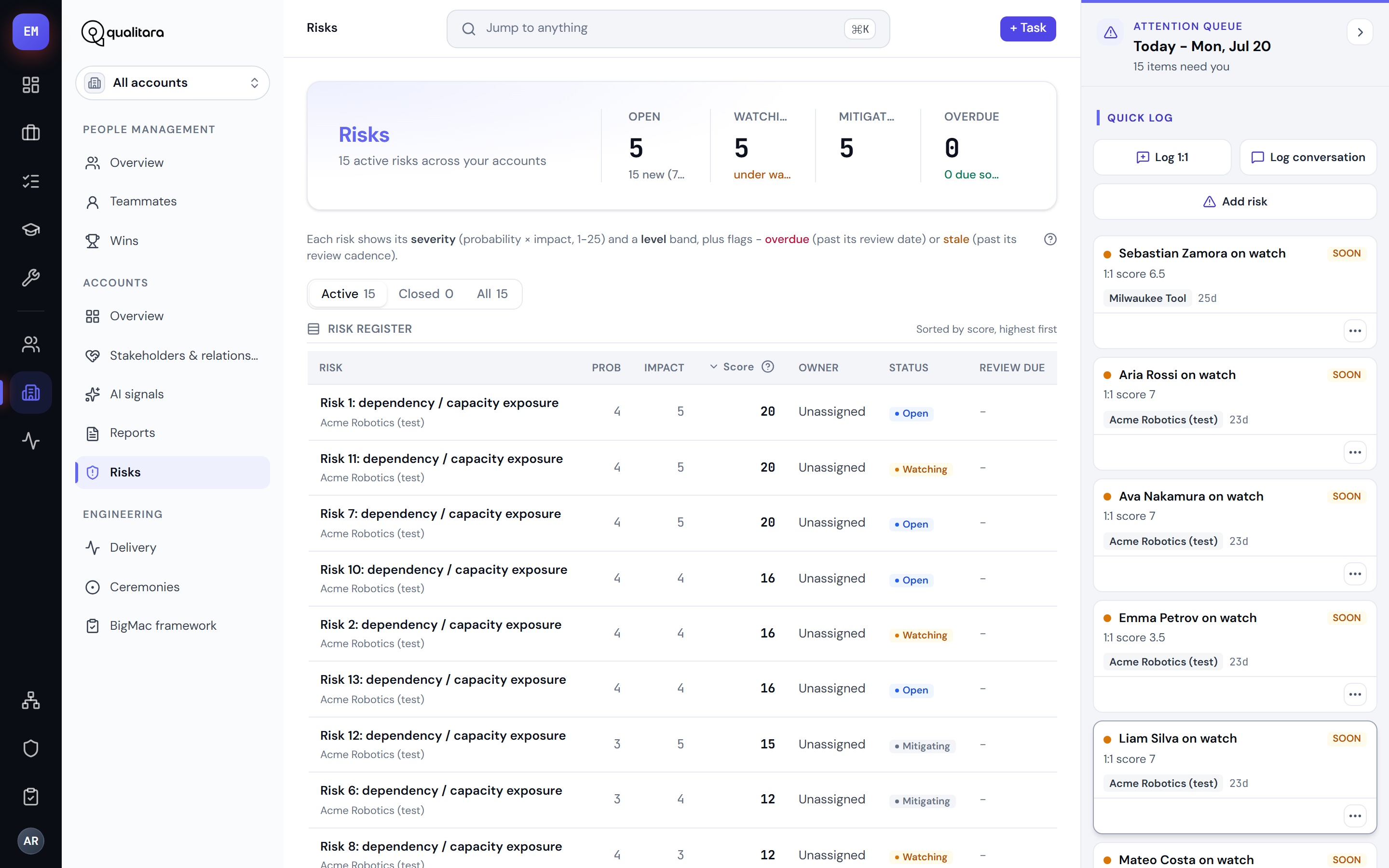
- em-risk-detector scans a call or note for customer, delivery and people risk signals, scores them on the 5×5 probability-by-impact matrix, and drafts the PRINCE2 cause-event-impact description - then waits for your yes.
- em-risk-apply-now creates only the risks you already ticked as proposals. It's idempotent with the evening closer, so a later run never double-creates.
- em-risk-reviewer walks your open risks and applies updates, closes or re-opens them - always after you confirm, always with a documented reason on the review log you see on the risk record.
- em-risk-escalator drafts the executive escalation email for founders, AM or CTO, centered on the specific decision leadership must make.
- em-risk-hygiene is the read-only punch list: overdue, stale, unowned, non-compliant. It never changes anything - it hands off to the reviewer.
8Stakeholders, conversations & OKRsAccounts
The account-side skills keep the relationship record current:
- em-stakeholder-mapper qualifies a stakeholder through the MEDDICC + Mendelow gates and records them - this is what feeds the MEDDICC and sentiment panels on
/relationships. - em-call-profiler and em-email-profiler are internal building blocks: they extract profile signals from a transcript or thread and hand them downstream; em-conversation-log-writer is the single writer for the conversation log, honoring each account's source policy.
- em-comm-plan-writer derives last-contact and next-due from the logged conversations and upserts the comm-plan touchpoints, with one changelog entry per change.
- account-changelog writes the audit-trail row for anything material on an account - a stakeholder change, an engagement stage change, an ownership handoff.
- The OKR quartet: em-okr-builder drafts and writes a quarter's OKRs (rubric-gated, Tability first, platform mirror second), em-okr-reviewer runs the mid-quarter check - pace per objective, the off-track escalation chain, the 80% pass-the-quarter simulator - em-okr-scorer closes the quarter with binary pass/fail scoring, and em-okr-auditor is the read-only quality audit.
9Task follow-throughFoundation
em-task-manager is the single gate for every task. Other skills - the 1:1 logger, the retro logger - never create tasks themselves; they surface action items and route them here. The gate runs an actionability check and de-duplicates by meaning (not just exact text), then a consequence check that maps each task to a priority and an Eisenhower quadrant. Tasks you create by hand skip the gate and are marked reviewed; tasks a routine proposes come in unreviewed for you to confirm.
em-artifact-drafter pre-writes a copy-ready draft into a task's body - an email, a doc outline - under a "review before sending" heading. It never sends and never creates an Outlook draft; the words wait in the task for you.
10Reporting & coaching
The reporting skills assemble; they never edit the underlying records. Each reads the spine, writes one idempotent report row, and renders the HTML (and an email draft where relevant) that lands in your Reports archive.
- em-mbr-builder (
/em-mbr) - the monthly business review brief per account, from wins, risks, OKR pace and relationship health. - em-board-report (
/em-board) - a board-ready summary plus an internal prep note that is never sent. - em-account-relationship-health and em-retention-report - relationship coverage and per-person retention trajectory.
- em-qualify-out-report (
/em-qualify-out) - the quarterly exit-decision review, idempotent per account and quarter. - em-report-redteam - cross-checks a finished report's claims against the underlying boards and writes one red-team review row; the original report is never touched.
Separately, the coaching skills grade you, not your team - one per practice area (1:1s, feedback, conflict, facilitation, interviewing, onboarding, offboarding, presenting), each scoring a single conversation against a fixed rubric into your owner-private Coaching dashboard. Two more personal instruments follow the same pattern: em-pulse-runner runs the anonymous quarterly pulse (aggregates only, never individuals) and em-meeting-load-snapshot snapshots your own week of meeting load, owner-private.
11The daily routines
You rarely invoke a skill by name. Two scheduled routines run the day, and both split the work the same way: a deterministic driver does the pipeline - the sweeps, the staging, the applies - and the LLM only logs and narrates. The hand-off between them is the platform itself: the morning stages proposals, you tick them on Home, the evening applies what you approved.
Sweeps every account you own, fuses cross-domain composite signals, stages judgment items as proposals (it never writes risks or feedback directly), and writes today's plan - leading with what changed since yesterday. Your Settings shape the run: which plan sections, your thresholds, and a weekly story day.
Auto-logs the day's factual captures by delegating to the domain loggers - 1:1s, standups, retros, profiles - stages conversation logs and carry-forwards as proposals for your tick, applies every proposal you approved (plus only the kinds your trust ladder marks auto), and closes the day with the summary you read on Today.
The trust ladder in Settings → Autonomy is the dial: per proposal kind, choose whether the closer may auto-apply or must wait for your tick. Everything either routine applies is on the Supervision ledger with undo and retry. A third routine, em-platform-backfill, replays the closer's factual captures over past months - safe to run because every write is idempotent. Weekly and monthly cadences add the standup team-health report and your 1:1 coaching scorecard (Mondays), and the MBR and pre-board reports (monthly and bi-weekly).
12Full skills reference
The skills you'll interact with most, what each reads, and what it writes. For the complete catalog including foundation and studio skills, see Plugins; for the databases behind them, see Data.
| Skill | When it runs | Reads | Writes |
|---|---|---|---|
qira | composite requests | your request + the catalog | nothing itself - dispatches the specialists |
em-1on1-logger | after a 1:1 | 1:1 transcript | 1:1 session + wins (+ private well-being) |
em-feedback-builder | coaching moment in a 1:1 | 1:1 transcript | feedback record + SBI email draft |
em-career-1on1 / em-goal-setter | career or goal conversation | the conversation | growth path (gated: SMART / four gates) |
em-conflict-logger | after a conflict surfaces | the conversation | conflict record (NVC-gated, owner-only) |
em-skip-level-logger | after a skip-level | session transcript | skip-level record + rollup |
em-onboarding-plan-builder / -reviewer / -closer | ramp start / checkpoints / close | plan + 1:1 signals | plan, proposed checkpoints (you confirm), close-out |
em-performance-review-drafter | review season | the person's evidence | one draft review - never rates, never finalizes |
em-standup-logger / em-retro-logger / em-ceremony-logger | after a ceremony | the transcript | ceremony log + red flags |
em-standup-weekly-report | Fridays | the week's standups | team-health report (no records) |
em-kickoff-logger / em-postmortem-logger | kickoff / incident | the transcript | kickoff or postmortem log (+ spawned tasks) |
em-risk-detector | you spot a risk | a call or note | risk (PRINCE2-gated, only on your yes) |
em-risk-reviewer / em-risk-hygiene | reviewing risks | open risks | updates / closes (you confirm) / nothing - read-only |
em-stakeholder-mapper | mapping a stakeholder | what you know of them | stakeholder record (MEDDICC + Mendelow gated) |
em-conversation-log-writer | logging a client meeting | call + account policy | conversation log entry |
em-okr-builder / -reviewer / -scorer | quarter start / mid / close | account context + Tability | Tability first, platform mirror second |
em-task-manager | any task write | your tasks | tasks (the single gate) |
em-artifact-drafter | pre-drafting a task | an open task | a draft in the task body (never sends) |
em-mbr-builder / em-board-report | monthly / bi-weekly | the record spine | report record + HTML / email draft |
em-pulse-runner | quarterly | survey responses | aggregates only - never individuals |
em-coaching skills | after your conversations | the transcript | your private coaching scorecard |
em-platform-morning-run / em-platform-closer | daily | your whole book | plan, proposals, applied approvals, daily log |